


The question of whether to spend on Chatgpt ads, and how much, has started showing up in demand gen meetings in one of two forms: either someone senior in the org forwards a news article with “should we be doing this?” in the subject line, or a paid media manager brings it to quarterly planning because an agency pitched it. Both land on whoever owns the budget, and both deserve a better answer than “let’s run a small test and see.”
This essay is my take at that question - including what the ads are, who sees them, whether you should buy them, and how to read the results - and then it goes on to suggest what to do differently depending on your key motion: e.g if you're self-serve the channel might be worth a real test today, and if you're enterprise-heavy the useful output may be knowing exactly why to say no and what would change that.
Do note that Everything here reflects what OpenAi has published as of 20 Aug 2026
ok, so what are these ads?
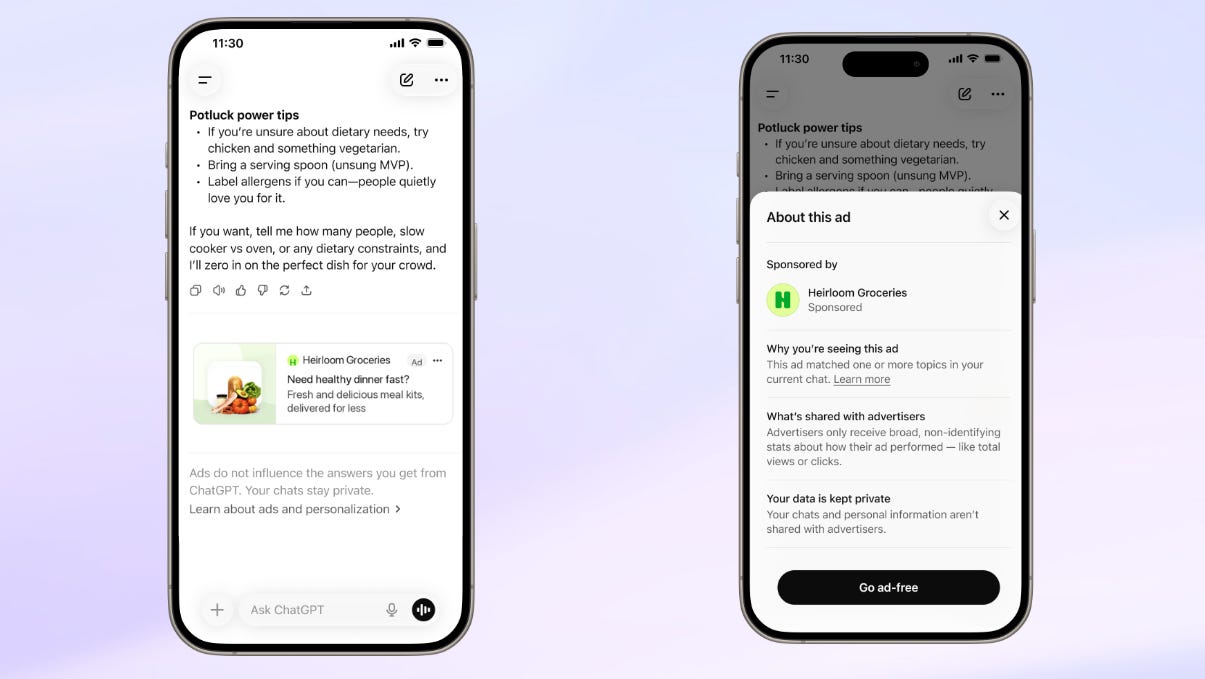
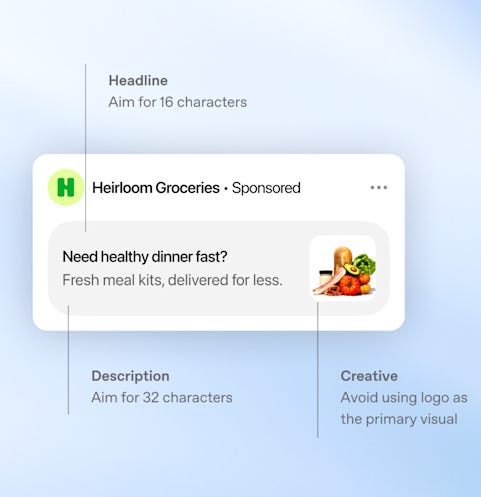
OpenAi began testing ads in Chatgpt in the US in early feb 2026. The ad unit sits below the response, labeled as sponsored and visually separate from the answer, with six parts: advertiser name, favicon, title, copy, landing page, and one image. There is no video/second headline so the craft is closer to editorial writing than performance copy :)
Character limits are the one spec to be careful with, because OpenAi asks you to stay within recommended limits without publishing them anywhere i could find, and agency write-ups cite anywhere from 16-50 characters on the title, so get the latest guidance from the live ads manager rather than a blog post (mine included!)
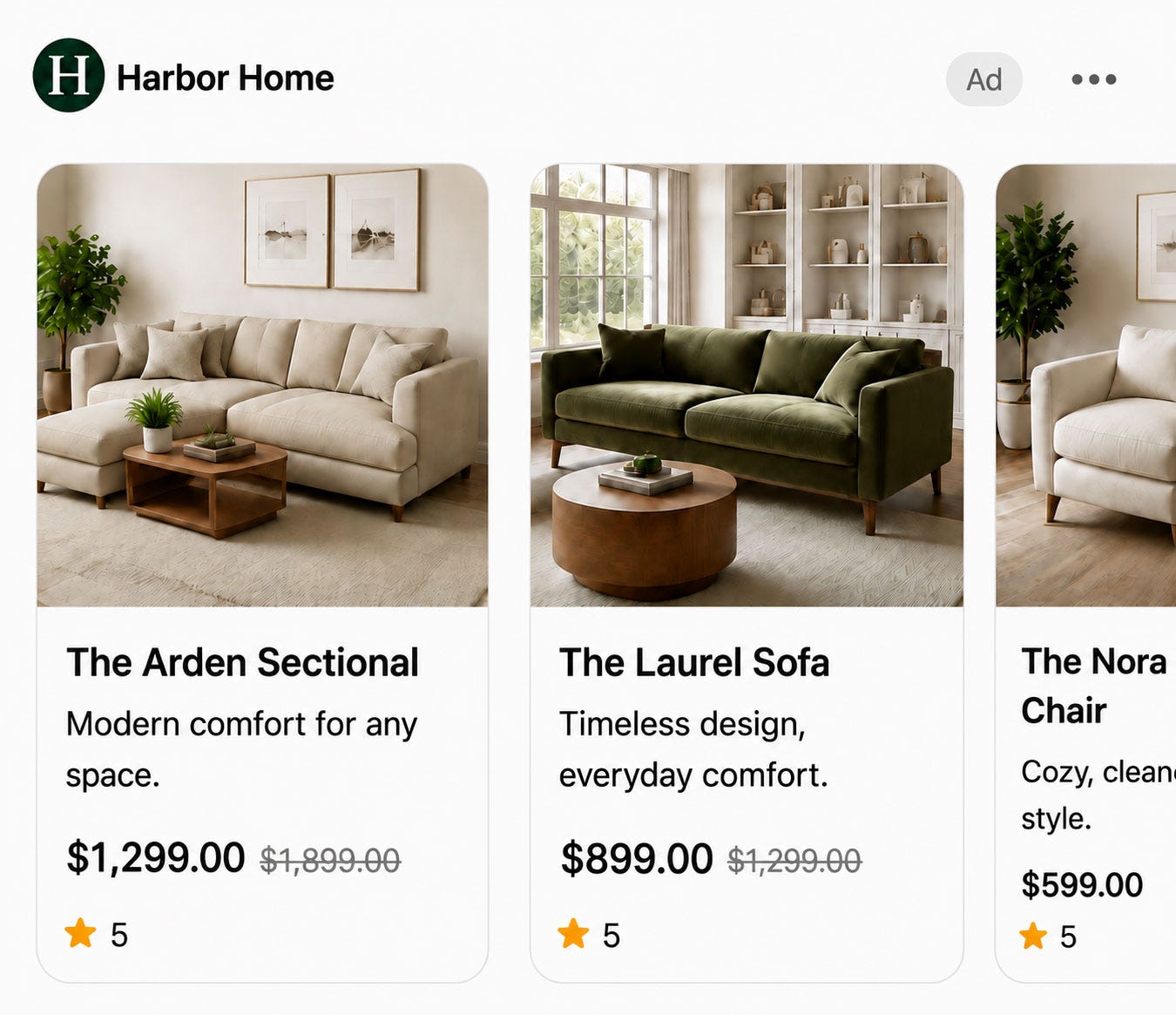
There’s also a multi-product carousel now live for product feed campaigns, which pulls from a retailer’s catalog and lets OpenAi’s system pick which products render
🤔 two quick things if you’ve seen the ads yourself:
the ad never appears inside the answer, runs on separate systems from the chat model, and renders only after the answer is complete
Ads skip temporary chats, the Atlas browser, and under-18 accounts. The placement rules loosened in April though: medical, legal, and financial advice conversations can now carry ads, while sensitive contexts like mental health stay ad-free and politics stays excluded
How does targeting work?
There are no keywords, cookies, or audience segments in the Meta sense. You write context hints at the ad group level, which are plain-language descriptions of the conversations where your product fits, and OpenAi treats them as guidance rather than exact-match keywords, so delivery isn’t guaranteed.
The targetable unit is a conversation’s intent, described by you in prose, e.g. “show us to someone mid-way through adding phone verification to a fintech app”, and writing that well is a craft very few demand gen teams have practised. Your buyer personas transfer almost nothing, and while geo-targeting arrived over the summer, there’s still no targeting by company, size, industry, or job title.
The one exception is Custom audiences, which shipped in July: upload email or phone identifiers, then include, exclude, or set a bid multiplier between 0.1x and 10x on a match. The catch is the floor of 25k matched users per audience (100k recommended), where matched means identifiers OpenAi could actually resolve.
🤔 another couple of pointers:
Re: Custom audiences: most ABM segments are nowhere near 25k matched people (unless you’re a large, or a very lucky, enterprise)
bid multipliers don’t determine eligibility, so 10x on your best accounts raises what you’d pay without making them likelier to be in the room
a matched user only sees an ad on Free or Go, so the servable pool is a subset of a subset
Where the ads run and who sees them
Through mid-Aug the list stood at 9 markets: US, Canada, Australia, New zealand, UK, Japan, South korea, Brazil, and Mexico. Then on 18 Aug OpenAi announced its largest expansion so far: 31 European markets including Germany, France, Spain, Italy, and the Netherlands, live within the week. Buying starts through OpenAi’s sales team and agency partners, with self-serve Ads Manager later this summer. One caveat for Europe: users control ad personalization in settings, so you must plan around contextual delivery rather than any personalised reach number
Then there’s the constraint that decides most of this piece for B2B: ads only run on Free and Go, with Plus, Pro, Enterprise, Edu, and every business plan staying ad-free. That excludes anyone whose employer pays for their AI tools, so senior engineers, economic buyers, and most of the champions running your evaluation. The people most likely to sign a contract sit structurally outside the audience, while the people inside it skew toward students, hobbyists, indie devs, and professionals who haven’t upgraded (that’s something i have heard from several enterprises now). For consumer retail that’s a fine crowd, but i think that for B2B the channel reaches the self-serve edge of your market and misses the centre
On the metrics/money
OpenAi supports CPM and CPC through a relevance-weighted second-price auction, and recommends starting CPC bids of $3 to $5, and now has conversion-optimized CPC in beta
measurement has grown past clicks: the OpenAi Pixel, a Conversions API, automatic advanced matching (default since 17 Aug), UTM passthrough, and integrations with Triple Whale and Hightouch as well
category eligibility is crucial too - especially as OpenAi now admits some US health and finance advertisers case by case while legal services still can’t buy and where B2B software sits hasn’t been spelled out publicly
The placement psychology (my favourite bit)
Search ads work because they intercept you before you have your answer: you typed a query, you’re still hungry, and the ad offers to feed you. Chatgpt ads invert that because the user asked, got a complete and usually pretty good answer, and only then does your card render underneath, so a meaningful share of your impressions land on people whose problem was just solved for free, right above your ad. I know i am oversimplifying this, but i am sure you know where i am coming from.
3rd party estimates put click-through roughly an order of magnitude below paid search, while Criteo reported LLM-referred users converting at around 1.5x other referral channels from a feb sample of 500 US retailers (i won’t read too much into as as the stats are aging and the Criteo sample is retail)
💡 3 things to note:
comparing this to paid search on CPM/CTR makes it look broken even when it’s working as designed, so the benchmark that might be meaningful at this time is probably conversion quality vs. Click volume
the organic answer frames your target category before you get to show up which means that if the model named 3 competitors and recommended 1, your ad below it is arguing with the referee after the whistle
(i like this one a lot) your ad performance and your presence in the organic answer are the same conversation seen from two sides - so funding the ad while ignoring how the model describes you is decorating the bottom of an answer that never mentions your brand
So should your company actually buy this?
Depends on what kind of B2B company you are:
self-serve, low ACV: if a dev or small team can find you, sign up, and pay without talking to anyone, buying today makes straightforward sense, because the free-tier crowd genuinely overlaps with people who convert for you. Might be good to run a small instrumented test with kill criteria written before launch
sales-assisted mid-market: the same audience can enter your funnel but as a lighter cohort than your average, so maybe fund the organic answer first and cap any test at a number you’d write off completely
enterprise, six-figure-plus deals: the tier exclusion removes essentially your whole buying committee if you’re a pure play B2b, because nobody on it might be using a free Chatgpt account for work. Custom audiences looks like the workaround but probably isn’t one yet, since your list may not clear 25k matches and the people on it sit on business plans where nothing serves
restricted categories: the decision is made for you already (which matters less than it sounds) because the organic work is the higher-return half for every shape anyway
📌 four questions i have been recommending to friends in B2b (before you pick up a longer effort)
would your typical converting customer plausibly have been on a Free or Go account when they first needed you? if no, you must stop here
can someone become a paying customer without a sales conversation? if not, signups will never be your metric so read on, but be cognisant of what you want to measure
does your funnel math survive a $3-$5 CPC against a lighter cohort once you drop the LTV assumption to match?
do the conversations you’d appear in even happen here? e.g., for dev-first products the high-value version often may run inside Codex, Cursor, or Claude Code, where there’s no ad inventory at all
How to read a million impressions and 10 signups
This is what most of the Demand Gen experiments are yielding so far in b2b and PLG —> SLG setups
almost nobody clicked: this is most probably a relevance problem because your context hints put you in the wrong conversations, or your title gave a satisfied reader no reason to keep going. Might be good to keep spending through one or two rewrites, because (a) the brief is the cheapest thing to change in the design, and (b) rewriting it is the skill the test was meant to buy you. If you’re still stuck after 3-4 rounds, good to stop
clicks but no signups: mostly a landing problem, because a conversational researcher might have hit a page built for search intent. They might be mid-exploration and need docs, a sandbox, or a comparison that continues the conversation they were having, and instead they got a demo form. The fix or the next iteration might be editing the page or tweaking the conversion paths
signups but no activation: If people signed up but never activated or upgraded, this might point to a cohort problem because you acquired lighter users than your usual mix (umm, exactly what the free-tier audience predicts?) and the fix might pricing the channel against what those users are actually worth vs. declaring it broken against your blended benchmarks.
What i see people struggle with is averaging the three into “Chatgpt ads don’t work”, which throws away the one thing those impressions bought you: enough volume to tell the three apart.
🪤 two traps on top:
if you’re enterprise-heavy, signups were never the right metryc possible, so might be good to measure it like a podcast sponsorship with branded search lift + self-reported attribution
guard against the opposite rescue as well - where a weak result might get relabeled as “brand awareness” after the fact, so good to pick the proxy before the campaign kicks off
Where i think the platform is heading
The general narrative as of today says OpenAi is far behind its revenue target, so business-tier inventory feels inevitable and B2B teams should get ready. i believed a version of that until i looked at what has actually shipped this year: self-serve buying in May, custom audiences and geo-targeting in July, then in Aug a product carousel, conversion-optimized CPC, advanced matching, measurement integrations, and 31 new european markets in the latest announcement.
Every release since feb has made the platform better at reaching the audience it already has (or larger in geography), but unfortunately the edge of that audience has not moved once as it still stops at Free/go tiers.
My guess is that opening ads to Business and Enterprise seats is close to the last thing OpenAi wants to do, because it means charging companies for a product and then advertising to their employees inside it, which is a much harder internal argument than shipping another format for retailers who are already asking. So plan for a longer wait than the growth coverage implies, or be very specific about what to measure and how much to invest.
My 2 cents on a decent experiment today
First, go ahead and fund the organic answer: e.g. docs a model can parse, accurate product descriptions in the places models read, agent integrations if you’re dev-first, a recurring audit design where you ask a few assistants to recommend a solution in your category and describe your product. The delta between what they say and what you’d want them to say is a pretty measurable marketing problem, and in a lot of companies nobody owns it yet
Second: treat Chatgpt ads as a small instrumented experiment with pre-written success and kill criteria, funded partly for the transferable skill of writing context hints, which compounds into the organic work anyway. Also, this reminds me that you should definitely do this five-minute check before launch: your landing page must be reachable by OAI-AdsBot and OAI-SearchBot, because if your robots.txt blocks them, the ad gets approved but then quietly never serves.
third, set a revisit trigger versus a revisit date: business-tier inventory appearing in any form, a meaningful drop in the 25k audience floor, or firmographic targeting in the ads manager (yes, the product releases do tell you more than the revenue headlines).
Writing this in late Aug, i don’t think the channel can carry B2B pipeline in any meaningful way yet, and the tier exclusion (enterprise/business) is enough on its own. But a small, cheap test won’t hurt if you want a baseline for later, once the B2B side improves. Also, worth remembering what sits right next to the ad → when a model builds an answer in your category, it either includes you or it doesn’t, and that is already deciding deals for a large set of enterprises, so go ahead and feel free to run a couple tests to learn how that surface works (because then the same budget would buy you two things instead of one.)