


Personal agents are where chat was 2 years ago and coding last year. Meta launched muse, with paid tiers at $20-$100 a month and became the most downloaded free app on the US app store in its first 2 weeks. Instinct doesn’t have an app per se; sits inside imessage/whatsapp and books tables and flights, shops etc. - crossed 100k+ users on invites only, just closed $1b at $10b (4x its valuation from a mo. ago), but is still limiting sign ups because it can’t get enough compute (very interesting discussions with the founder here). Grok bot - where most of my personal life sits right now - launched with a similar idea, Openai launched dots at Devday last week but only on its $100-500/month pro plan, and apple is rebuilding Siri.
It’s still very early and, to be honest, it feels pretty wild wild west on some mornings, so nobody knows how big it gets or who wins yet.. but sharing some of my thoughts on how it may play out and my bets (📌 ) for the next 12 mos.
What the last few waves tell us?
In Search, bing built its own index but people stayed on google out of habit, and google paid apple ~$20b/yr to stay default on iphone [great read], so apple made money just by owning the surface. In chat, Chatgpt kept most users after others caught up with Openai's model, because it had their habit + memory. But then coding showed what actually keeps users - devs switched to claude within weeks because claude wrote better code, and claude code then put it inside their terminal + repo, so they stayed there when other models caught up
I think personal agents will go the coding way, because (1) as a user you can see the results really quick and (2) a mistake costs real $. I’d any day pick an agent that gets a booking right 9 out of 10 times than the one which gets 7, and one that can solve for everything from flights and restaurants and my electricity bill payments vs solving for 1-2 bespoke use cases. So every better model is going to pull users for a few weeks/months, and whoever uses that window to lock in memory, permissions and the interface users talk to the agent, gets to keep them.
Who gets to play?
Anish (a16z) tweeted that a personal agent costs ~$3k-7k per user per year to run right now. Instinct is probably near the top of that range since it pays API prices, and clicking through websites burns a ton of tokens. Meta runs its own model on its own servers, so it probably pays 10% of that, and will only get cheaper as it grows because the same servers will run whatsapp, insta and ads. Muse/ Instinct made it free while Openai kept dots on its pro plan, showing that even a lab with its own model isn’t ready to eat all that cost yet. Now, costs will continue to fall (model prices dropped ~10x last year), but a startup on API prices will still pay ~10x what the labs pay (that gap is going to make the lab’s profit).
📌 i think the general assistant will end up with whoever owns a model + the interface/device users talk to, and instinct (or any other incredible independent agent) either sells to one of them or keeps raising every year until it does. So the next wave of consumer hardware (meta's charm, openai's device, glasses) is a fight over who gets to own the agent, and phones will get judged on their agent the way they get judged on cameras today.
What’s going to happen across the Personal ai agent value chain ?
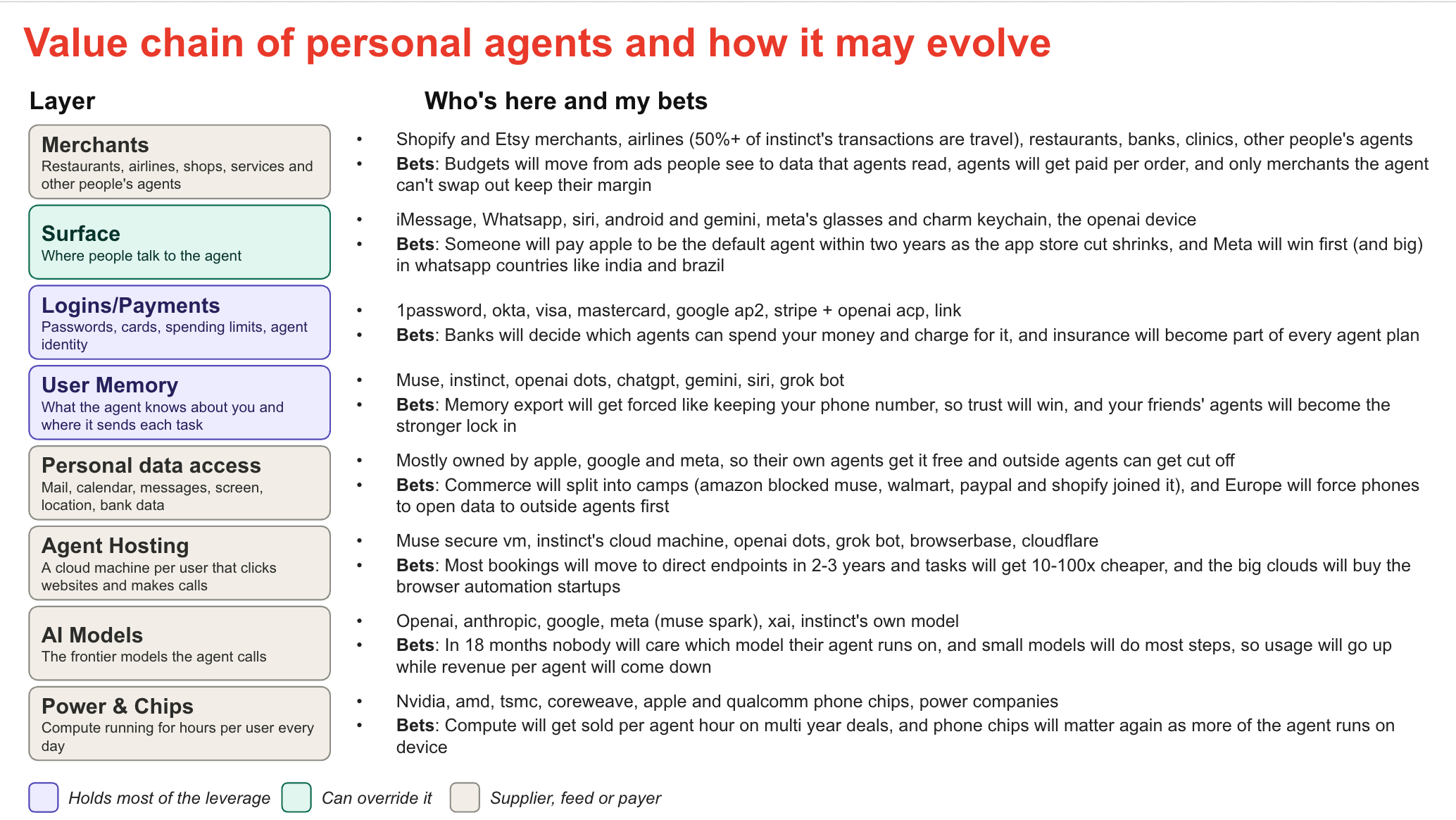
Power/Chips: a chat ends when you close the tab but an agent runs for hours every day so the inference capacity will become the bigger constraint before training capacity does.
📌 I think compute will very soon will get a new pricing model - getting sold per active agent hour on multi year deals - so agent companies will push merchants hard for direct endpoints to cut task time.
📌Also, phone and laptop chips will start to matter again - every task that runs on device will save cloud cost, which is going to pull Apple and Qualcomm into the agent race
AI Models: 5+ labs are sitting within a few months of each other and the leaderboard keeps changing every other week. But we will be seeing diminishing returns very soon - at the point the assistants will just dynamically send each task to whichever model is cheapest that week
📌 in 18 months time, people will know their assistant’s name and not care what model it runs on. Which also means that a lab without its own surface will become a supplier on price.. and this is why every lab is racing to own one.
📌 I also think that most agent steps (reading a page, filling a form) will all run on small cheap models with the big model only planning, so labs will see usage go way up while revenue per agent will come down.
Agent’s Computer/Hosting: Muse, instinct and Dots give every user a cloud machine that clicks through websites like a person but that’s only because because most merchants can’t talk to agents yet. AP2 (60+ partners), ACP, UCP and cloudflare’s agent tools are changing that, and a task through a direct endpoint will cost 10-100x less.
📌 Within 2 yrs majority of the bookings will go through endpoints and browser clicking will become a fallback for small merchants. Meta/Openai’s cost edge will shring then and startups will get a second shot, but by then memory lock in will matter way more than cost.
📌 Browser automation startups running these machines will probably get bought by the big clouds, and agent hosting will become a standard cloud product like databases.
Personal Data Access: Email, calendar, messages, screen, location, bank data etc - Apple, google and meta own most of it, so their own agents will continue to get it free and outside agents can get cut off anytime.
📌 I think commerce will split into camps, the way streaming split into exclusives. Amazon already blocked muse, and right after paypal, walmart and shopify signed up as partners, so the agent with the most merchants in its camp will win users.
📌 Oh, and Europe - I suspect it will force apple and google to open phone data to outside agents like it forced open app stores, so outside agents will work better in Europe first.
User Memory: I think most of the pricing power sits here. After a few months your agent will know what you eat, who you text, what you spend and where you travel, and it will pick the model, merchant and route for every task. Instinct even keeps copies of your inbox after you disconnect it - they know memory is the asset ;)
📌 Regulators will force memory export like they forced carriers to let you keep your number (Number portability → Memory portability), so winners will let you see and fix what the agent knows, because people who trust their agent won’t move even when they can.
📌 The stronger lock in will come from other people’s agents though. Instinct’s agents already coordinate with your friends’ agents, and once your family is on the same agent, leaving is going to be as hard as leaving whatsapp.
Identity & Payments: Instinct needs your passwords and MFA codes in full and its terms make it your legal agent, which I don’t think banks will allow for long. Muse already uses a password store the agent can’t read + one time card numbers. Most agent mistakes will land in this layer (and you will see it first on X or hackernoon) - e.g openai launched dots a day after apologizing for its agents posting 53 users’ images online, and each mistake will bring new rules on confirmations/Spending limits.
📌 As step 1, banks will become the gatekeepers and will decide which agents can spend your money..and in step 2 they’ll charge agents for that access
📌 Insurance will become part of every agent plan the way fraud protection is part of every credit card, so the price of an agent will include who has to pay when it gets something wrong.
Interfaces & Devices: Instinct lives inside imessage and whatsapp, which apple + meta own, so they can block it or drop their own agent in the same chat. I think whoever owns this sets the rules for everyone below this layer.
📌 This might take a while but i am sure that at 18 months mark from today, one of the larger assistants will pay Apple to be the default agent on iphone.
📌..and apple will want it badly, because agents don’t open apps - so the 30% app store cut will shrink and the default agent deal will replace it
📌 Meta’s biggest win will come outside the US - in India, Indonesia and Brazil where whatsapp already is the phone - - and Muse is going to get there before apple or Openai can.
Merchants & Services: the agent picks which restaurant gets the booking and which airline gets the ticket. Instinct’s founder said more than half its transactions are already travel and it’s nearing $1b a year with a 14 person team, so this is already happening.
📌 I think merchant budgets will move from ads people see to data agents read
📌 Marketing will go from measuring which ad got the click to which agent sent the order
📌 Agents will get paid per order they send, like booking.com does per hotel stay, and loyalty programs will have to win over the agent (as it picks on price, reviews, history etc.)
But, the agent will only take the margin it can swap
One interesting thought i’ve been noodling on recently is that an agent can easily move my dinner to another restaurant - so restaurants will pay to get picked, but it can’t move my mortgage or my seat on the next flight, so my bank and airline will continue keeping their margin and the agent will just call them.
The above distinction is important because people will keep one primary agent like they keep one phone, so the money in finance will stay with the licensed lender and the bank. For companies building something in this value chain, they got to ask if an agent can swap them out.. if it can, they either need something nobody else has (Carbone tables, a licence, extraordinary taste or UX) or they have to pay big $$ to get picked.
Who else gets paid, and who loses?
The companies around the agents will get paid no matter which agent wins. Every agent needs a phone number, email and voice, so Twilio, Sinch, Bandwidth etc will sell to every agent, and since an agent calling for a human looks like a robocall, Carriers will need to verify which agent is calling for whom, which will turn Comms companies into Identity companies too. Okta and 1password will charge per agent on top of per person, visa and mastercard will clear every agent purchase only with proof of what you allowed, and Security vendors and insurers will get a new category because an email telling your agent to send money will become the new phishing.
📌 Apps will lose the most because agents will call endpoints instead of opening apps, so the hotel, bank and airline apps will keep your business but lose you as a user.
📌 Travel sites and delivery apps will either become what agents call and keep their cut, or agents will go straight to the airline and restaurant.. depends on who builds a good endpoint first.
So what comes after the agent?
With search we typed keywords and read 10 links, with chat we typed a question and read 1 answer, with agents we are typing a goal and reading a confirmation.
In every step we did less and the money moved closer to the actual purchase. Chatgpt’s checkout inside chat got pulled within a month because people still had to sit and choose, while instinct already texts people before they ask, so the next step is going to be the agent acting without you asking at all.
📌 My biggest bet for where this all goes next is Standing instructions.
We will set our preferences and limits once, they will sit in a wallet with our identity and permissions, and every service will run its own agent against it.. my airline will rebook the cancelled flight, my bank will move the money to cover it, and I will see a list of what got done with an undo button next to each. Google’s signed mandates are an early version of that wallet, and once it exists nobody will need to chat with an agent, the subsidy war will end because there’s no per user cloud computer to pay for, and the money will go to whoever holds your wallet (Apple, google, card networks, banks).
I suspect the first real versions of it which break the internet will show up before the next 12 months.