


For almost everyone commenting on the future of jobs, the standard way to think about AI and work is subtraction. A job is a list of tasks, AI can do some of them, so cross those off and look at what remains. Blah.
It is a tidy method but it has a fatal limitation: it can only ever predict shrinkage. Start from existing jobs, remove things, and the best case is a smaller version of what already existed. The method has no way to generate a job that did not exist before, which is awkward, because that is where almost all employment has historically come from. When you poke people more on their commentary, every honest version of their subtraction story ends with a shrug about “new jobs we can’t yet imagine.”, and in my head that’s what tells me that the method is incomplete.
Here is probably a better mental model and something i use when this topic comes up on dinner table with friends and Startups.
When the cost of a task collapses, the interesting thing is not which jobs lose that task, but instead which new jobs become worth creating now that the task is nearly free. The simplest example that almost everyone, from my mom to the founder of a conversational cafe operational agent builder, resonates with is the printing revolution and the end of it. Printing did not just subtract copying from the scribe - made copying so cheap that a new bundle of work, deciding what was worth copying and fixing it before it went out, became a full-time role for the first time. That role is the editor, and it was economically impossible while a human hand was the bottleneck, so the press did not shrink the scribe into a smaller scribe, but rather set a pile of tasks loose and a new occupation condensed out of them.
In my discussions, I call it recomposition - tasks come unbundled from old jobs because they got cheap, and then some of them rebundle into new jobs that were previously uneconomic to put on one desk. The whole action is in the second step, and subtraction is blind to it because subtraction, obviously, never adds anything back.
Once you see work this way, the question changes. The useful thing to ask about a freed task is not “whose job did this come from” but “what new bundle does this make possible.”
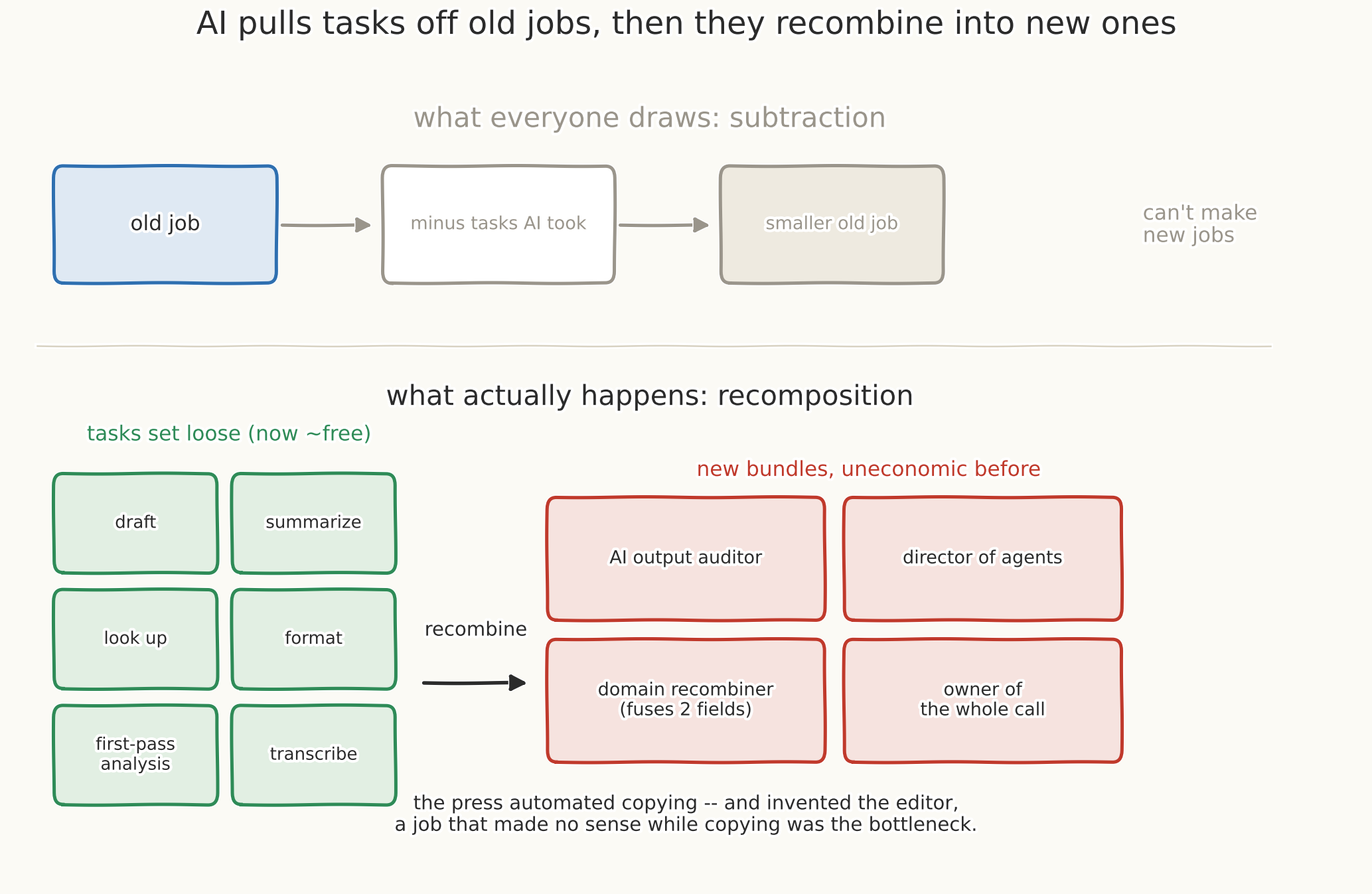
With AI, you can already see the first candidates forming- someone has to specify what the model should do and judge whether it did it, which is a real job and not the old one minus tasks. Someone has to catch the model’s confident mistakes, which is a different skill from producing the work in the first place. Further out, the more interesting bundles fuse things that used to live in separate roles, because the connective work between them is now cheap enough that one person can hold both. I think that is where genuinely new titles would come from vs. defending old ones.
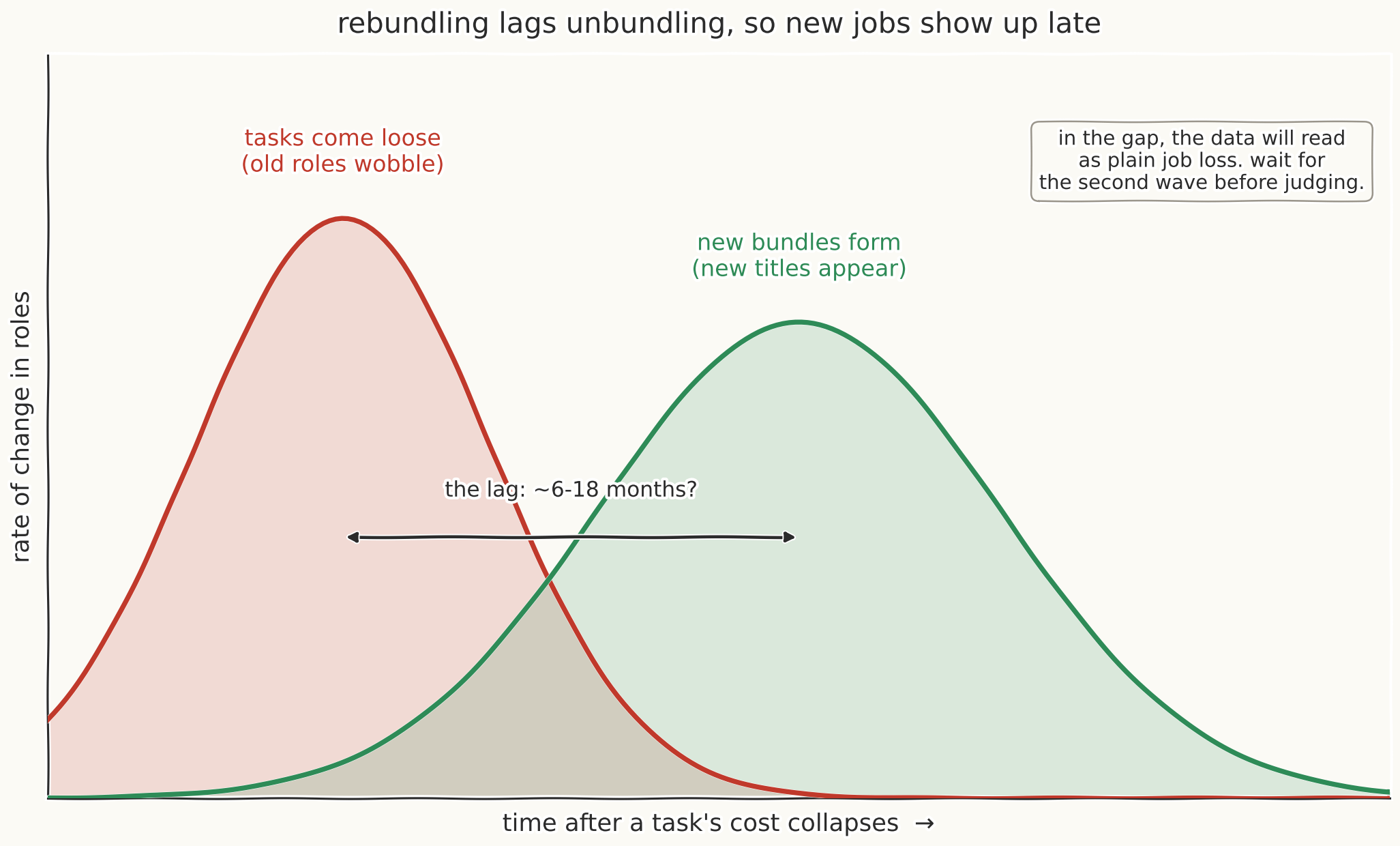
This leads to the first prediction I am willing to be wrong about - new job titles should cluster a few years after a task collapses, not at the same time.
Unbundling is fast: because making something cheap is a step change. Rebundling is slow: because someone has to notice the freed tasks, imagine a coherent role around them, and trust the automated pieces enough to build on top.
My guess is a lag of roughly 6 to 18 months atleast between the wave of tasks coming loose and the wave of new roles appearing. If new titles instead show up immediately, or if the lag turns out to be longer than 2 years, the model may need a rethink (alright), and I would think again on what additionally needs to be baked in. The practical sting is that in the gap, it will look like straightforward job loss, and a lot of policy will be written about a level when the real story is a delay.
The second question is which recompositions actually hold, because not every imaginable new bundle becomes a paying job.
The usual instinct is that complex work is safe and simple work is doomed. There’s definitely an aspect of it, but i think another dimension that really makes a bundle stick is whether it concentrates accountability on a single human (or, role). A job is often less a way to get tasks done than a way to have one identifiable person answerable when they are not. That function does not automate, because you cannot sue a model and you cannot reassure a frightened customer by pointing at a server.
So the roles that would survive stronger are the ones where liability sits heavily on a named person / role, almost regardless of how hard the underlying tasks are. E.g. a ship’s captain does little that is technically difficult on a calm day, and the role is not going anywhere, because someone has to be the person who answers for the vessel. A radiologist survives for the same reason a notary does, not because their tasks share any difficulty, but because both are structured so that one human carries the consequence. Meanwhile, plenty of cognitively hard work with no concentrated liability, technical translation, draft document review, quant research support, automates quickly precisely because no one needs a throat to choke when it is wrong.
This is my second prediction, and it is also highly testable: rank roles by concentration of liability rather than by task complexity, and that ranking should predict survival better. If complexity turns out to predict it better after all, then yes, again, the model needs a more sophisticated articulation.
Put the two together and my advice for anyone running an organization is concrete - stop auditing your jobs for which tasks AI can take, because that only ever tells you how to get smaller. Audit instead for two things:
first, which freed tasks could combine into a role you do not currently have, because that is your next hire and probably your next advantage.
second, for each existing role, ask whether anyone is genuinely accountable underneath the tasks, because if the answer is no, you were funding a task that wore a job title, and AI is only going to make that more obvious.
I strongly feel that the roles worth protecting are the ones would be where a human carries the weight when it goes wrong, and the rest were always just tasks waiting for their price to fall.