


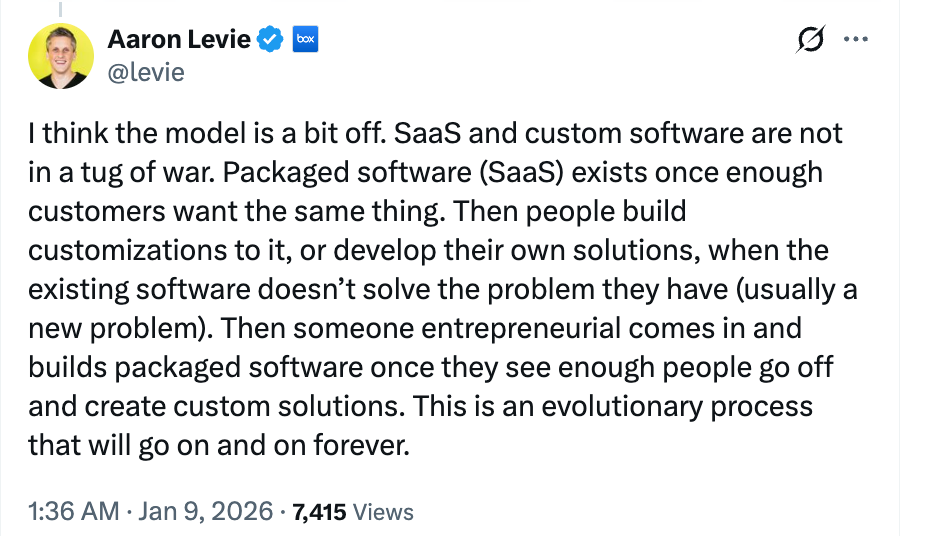
Aaron's observation here captures a shift I've watched unfold firsthand. When I started working in tech in the early 2010s, building software meant something completely different than it does today. I watched engineering teams routinely spend months building internal tools because packaged software never quite fit their specific needs.
Take project management for example - Microsoft project and Basecamp existed and worked fine for traditional project planning. But engineering teams doing agile development needed something quite different - sprint planning, story points, burndown charts, continuous deployment tracking. The initial artefacts of existing tools were built for waterfall, not iterative development. So I saw teams build their own: custom jira plugins, homegrown dashboards, internal sprint management systems.
By 2012-2013, enough companies had built similar solutions that entrepreneurs recognized the pattern. Atlassian evolved jira to support agile workflows. Asana and Monday.com launched with native sprint support. The custom solutions had revealed what the market actually wanted. This first cycle took roughly 5-7 years from widespread custom building (2006-2011) to mature packaged alternatives (2012-2014).
Then the cycle repeated: By 2016-2017, even these agile-native tools weren’t enough. Teams needed cross-functional coordination - linking github commits to jira tickets to production incidents to slack notifications. So they built custom integrations again: bots, webhooks, Zapier workflows, internal dashboards pulling data from five different tools. The pattern emerged again, and by 2019-2020, companies such as Linear, Height, Shortcut launched as “engineering-first” tools with native git integration and workflow automation built in. Another 5-year cycle.
For decades, this is how SaaS evolved through a predictable cycle: customers built custom solutions to fill gaps, entrepreneurs spotted patterns across these custom builds, and new packaged software emerged to serve the market. It was methodical and slow. That world is gone. AI is compressing these cycles from years into months - or in some cases even weeks.
The AI compression
AI hasn’t eliminated this evolutionary cycle but has dramatically accelerated it and changed how it manifests. Here’s what’s different now:
Micro-SaaS explosions are happening in weeks, not years. Someone tweets “I built a GPT wrapper for sales emails” and within days, fifty similar apps launch. The market that took years to develop now consolidates to 2-3 winners within months. Look at AI SDRs for example: companies were building custom AI email workflows in early 2023, and by late 2023, 11x, Artisan, and AiSDR had all launched as packaged products. Six months later, companies are already building custom layers on top again - proprietary data enrichment, vertical-specific messaging, multi-channel orchestration.
Configuration is becoming the new customization. You don’t need to build custom software anymore - you configure AI behavior through prompts and context. But this creates new standardization opportunities. Someone will package “the 50 best Claude prompts for sales teams,” people will customize those for their specific needs, and someone else will package those vertical-specific versions. The cycle runs faster because the barrier to both customization and packaging has collapsed.
The cycle is oscillating continuously instead of proceeding in clean stages. Take tools built on Claude - companies build custom workflows, share what works on Twitter, others package those patterns into templates, users immediately extend those templates with their own modifications, and the cycle repeats weekly. Companies and their users are iterating together in real-time, over weeks instead of years, with each side learning from the other continuously.
Distribution is becoming the moat, not product differentiation. When anyone can spin up an AI sales email tool over a weekend, Lavender, Instantly, and Smartlead all do roughly the same thing. Custom solutions using Claude and a CSV file work fine technically. But companies buy Lavender anyway not because it’s uniquely capable, but because enterprises trust known vendors. The cycle shifts from “build better capabilities” to “build trust and integration ecosystems.”
The fundamental insight remains true: packaged software emerges when enough customers want the same thing. But “enough customers” now means dozens instead of hundreds, and “emerges” means months instead of years. The cycle hasn’t disappeared but rather fractalized into multiple layers iterating simultaneously, each moving at AI speed.
So, what happens when building becomes free?
We’re not just seeing faster product cycles now but also watching the line between using software and building software disappear entirely. When you can describe what you want in plain english and have it exist seconds later, the old startup question “what should we build?” stops making sense. The hard part isn’t building anymore. It’s getting people to pay attention to what you built.
Software is becoming so easy to create that the code itself barely matters. What matters is whether people trust you enough to use your version instead of building their own.
Think about why salesforce still dominates CRM despite countless competitors with better features - not because salesforce has the best UI (umm!) or the fastest performance. It’s because your sales team already knows it, your CS team has dashboards built in it, your revenue ops have years of data there, and your finance team’s commission calculations depend on it. Switching would mean retraining 200 people, rebuilding 50 integrations, and risking your 2026 pipeline during migration. The switching cost is so high that even a meaningfully better product can’t win.
This is what “becoming the place everyone agrees to meet” means in practice. Products win by accumulating gravity - more users means more integrations, which means more consultants who know the tool, which means more templates and best practices, which means more new users. Once this flywheel starts, it’s almost impossible to stop.
The same logic applies to trust - when your procurement team evaluates AI tools, they’re not just comparing features. They’re asking: Will this vendor exist in two years? Will they keep our data secure? Do other enterprise customers use them? Can we get them SOC2 certified? Will our auditors approve this? A startup with better AI might lose to an established vendor simply because the buyer needs to justify the purchase to their boss, and “nobody ever got fired for buying [established vendor]” still holds true.
This dynamic creates several specific implications for what comes next:
Vertical software might disappear. Why would a hospital buy “AI medical scribe for radiology” when they can take Chatgpt Enterprise and load it with radiology protocols in an afternoon? The value shifts from vendors who hard-code industry knowledge into software to platforms that make it trivially easy to add any context. Doximity and Athenahealth spent years building healthcare-specific features. Now a general AI platform with the right prompt library might be good enough.

Professional services will become way more valuable than software. If the code is commoditized, the humans who configure it capture more margin. Look at what’s happening with Zapier and Make - the platforms are cheap, but companies pay consultants $200/hour to design the right automation workflows. As AI makes building easier, implementation and strategy consulting could become more lucrative than selling licenses. The Accentures of the world might matter more than the SaaS vendors.

Integration access will become the real moat. When twenty AI SDR tools use the same underlying models, the winner is whoever has the deepest access to salesforce, outreach, linkedIn, and zoomInfo APIs. The product moves beyond AI to having OAuth connections to 50 enterprise systems and the ability to read context from all of them. This is why salesforce and hubspot are building AI features aggressively: they already own the data pipes.
Software will become ephemeral and generated on-demand. Instead of maintaining one product for thousands of customers, why not generate a custom version for each buyer? Imagine an agentic layer that spins up a bespoke CRM for your specific sales process, generates it fresh when you sign up, and throws it away when you churn. Software starts looking more like consulting deliverables than traditional SaaS - built once per customer, not built once for everyone.
Compliance timelines will end up becoming the biggest bottleneck. In regulated industries, getting SOC2, HIPAA, or FedRAMP certification still takes 12-18 months no matter how fast you ship features. First movers who clear compliance hurdles get 12-month head starts that are almost impossible to overcome. By the time competitors get certified, the market has already moved to the next thing. Harvey (legal AI) and Nabla (medical AI) are winning because they got through compliance first and not because they have better models.
Community becomes uncloneable. I love this one! When your product can be replicated in a weekend, the community around it can’t be. Notion’s 10,000 template creators, airtable’s consultant network, figma’s design system libraries - these took years to build and can’t be copied by a competitor with better features. The software becomes the excuse to join the community, not the product itself.
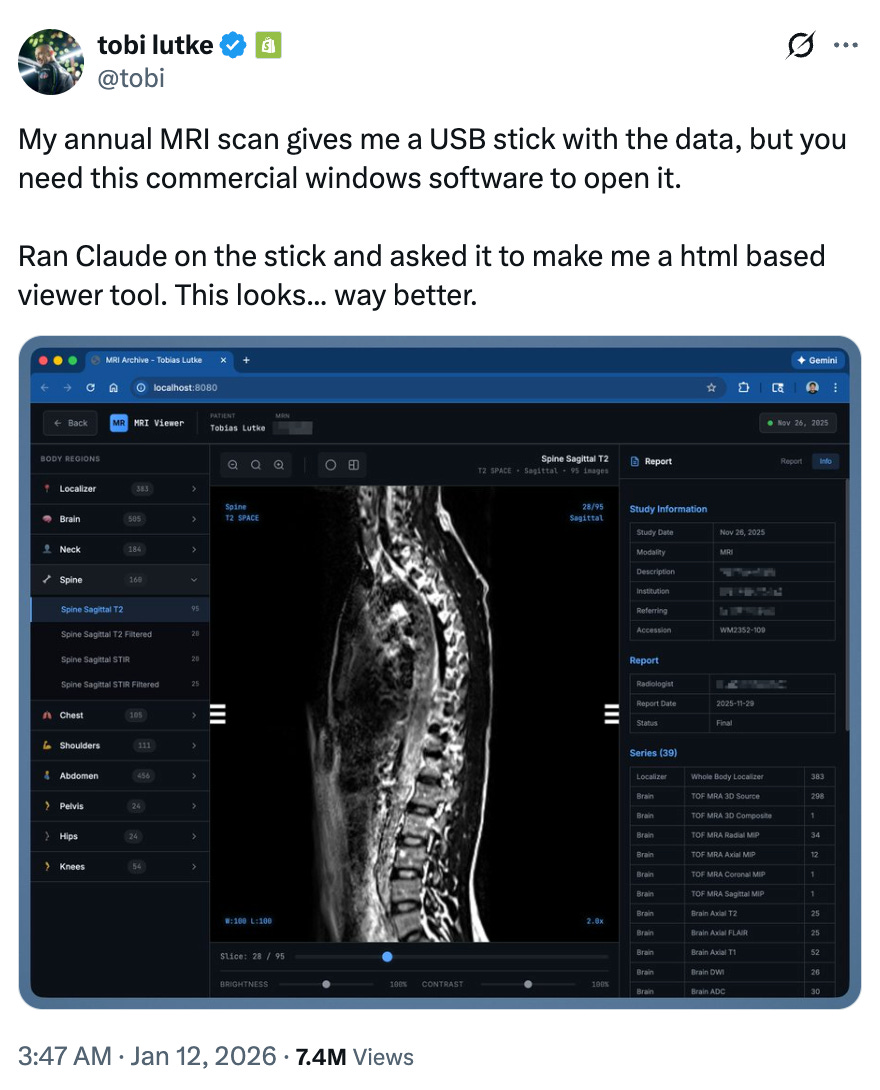
I believe that this evolutionary cycle will keep going. But when evolution happens this fast, we’re not watching slow adaptation over years - we’re watching new species appear every week.
The companies that survive won’t necessarily be the best builders or the fastest movers. They’ll be the ones that understand what actually matters has shifted: from “can we build this?” to “do customers trust us enough to use our version instead of the fifty others launched this month?” Building the product is table stakes now. Everything else - the integrations, the compliance certifications, the consultant networks, the community - is what’s going to determine who wins.